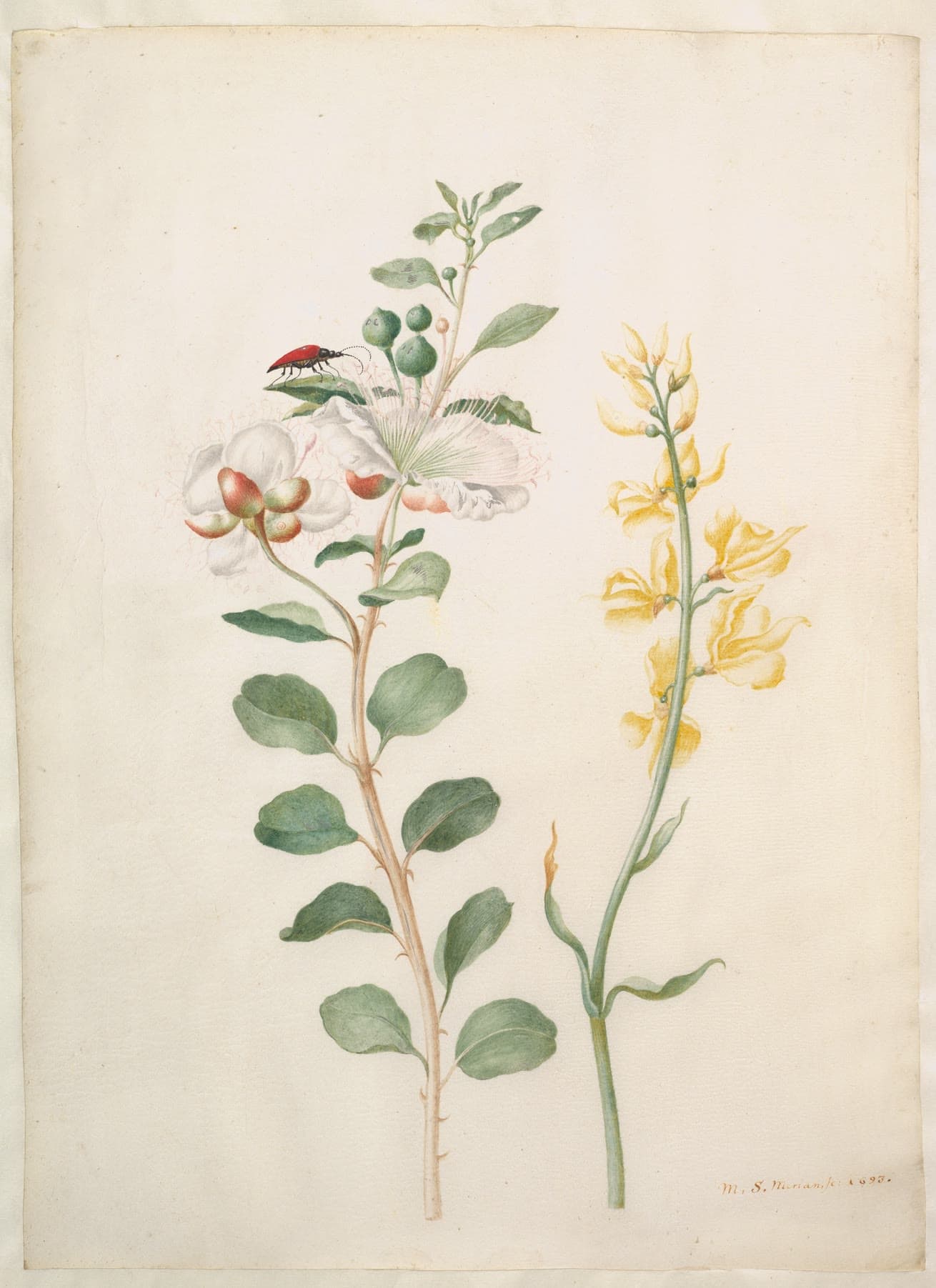
Spiders, Ants, and a Hummingbird
The plate that convinced no one in Europe — until it was confirmed true.
- Work
- Spiders, Ants, and a Hummingbird, Plate 18, from Metamorphosis Insectorum Surinamensium
- Artist / naturalist
- Maria Sibylla Merian
- Origin & date
- Amsterdam, 1705
- Held by
- Wikimedia Commons (British Library)
Format
The full-resolution scan, color-managed to the source — yours to print, study, and keep.
Size
$19.00
The story
Maria Sibylla Merian self-funded a two-year expedition to the Dutch colony of Surinam in 1699, an extraordinary undertaking for any 17th-century naturalist and a genuinely radical one for a woman working without institutional backing, to document the insect life of the South American tropics through direct field observation rather than secondhand report. This plate, from the resulting Metamorphosis Insectorum Surinamensium (1705), shows a pink-toed tarantula looming over a hummingbird carcass while leafcutter ants march up a branch in strict formation — a scene European naturalists dismissed as fantastical exaggeration for over two centuries, since large spiders preying on birds seemed obviously impossible. Field biologists have since confirmed several tropical tarantula species do occasionally take small vertebrates. What to notice: Merian drew every stage of a creature's life cycle in a single composition whenever she could — this plate compresses predation, colony behavior, and web architecture into one continuous scene, decades before ecology existed as a discipline.
About this reproduction
- Faithful reproduction of a public-domain work, sourced from Wikimedia Commons (British Library)’s open-access release.
- Printed to order on 200gsm EMA matte art paper: smooth, no glare.
- Color-managed to the source scan.
- Ships in 5–8 business days; satisfaction guarantee.