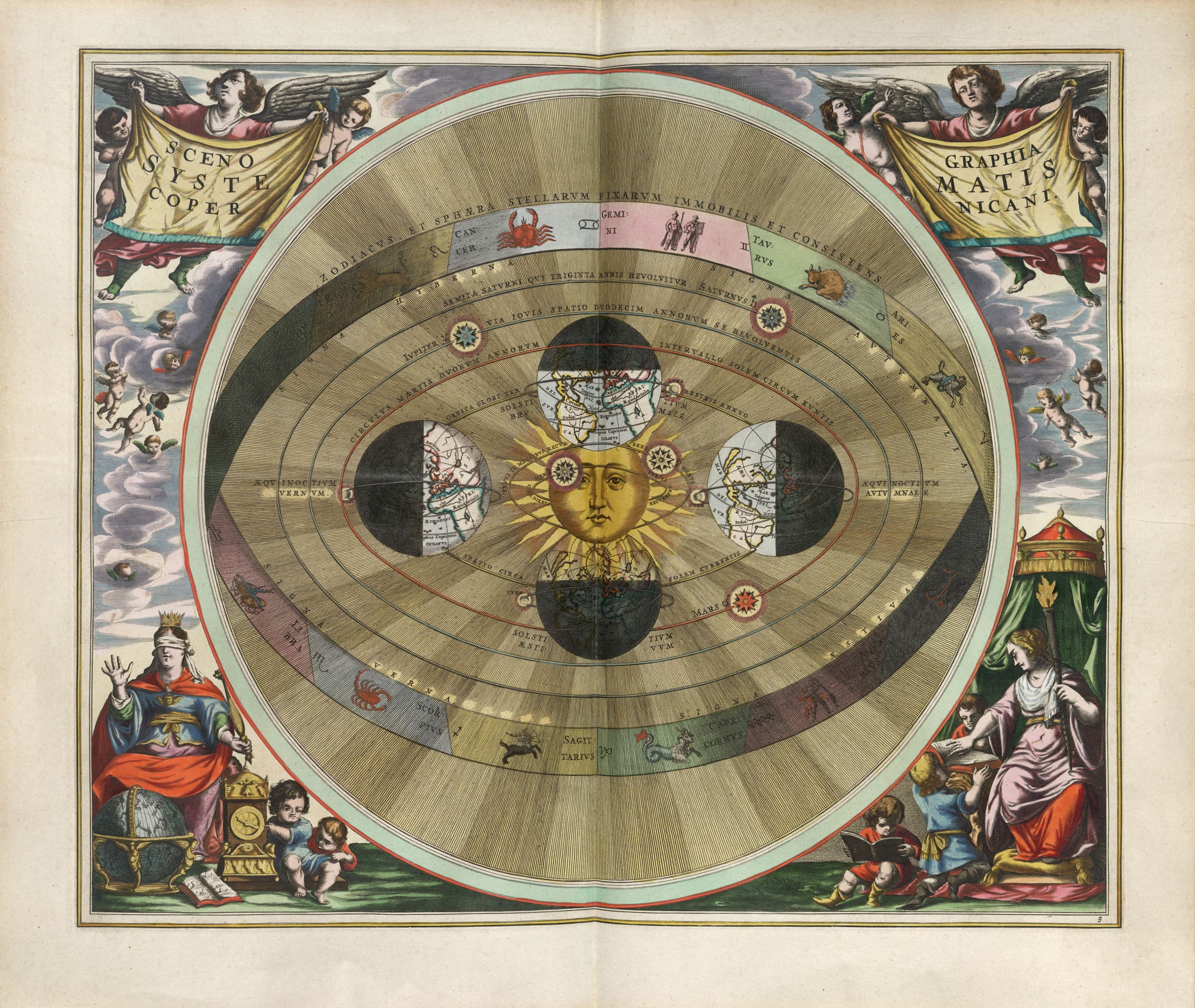
Hypothesis of the Ptolemaic Eccentric and Epicycle
A working diagram of the Earth-centered universe, drawn like a jewel.
- Work
- Hypothesis sive Communis Motus per Epicyclos, from Harmonia Macrocosmica
- Artist / naturalist
- Andreas Cellarius
- Origin & date
- Amsterdam, 1660
- Held by
- Wikimedia Commons
Format
The full-resolution scan, color-managed to the source — yours to print, study, and keep.
Size
$19.00
The story
Where most of Andreas Cellarius's Harmonia Macrocosmica (1660) plates picture full mythological star-figures, this one is purer geometry: a technical diagram of the Ptolemaic model's eccentric orbits and epicycles — the nested, off-center circles ancient and medieval astronomers used to explain why planets appear to slow, stop, and briefly reverse course against the fixed stars. Even here, Cellarius surrounds the diagram with his characteristic Baroque flourish, ornate strapwork and rearing horses framing what is, underneath the decoration, a genuine explanatory tool. What to notice: Ptolemy's system, however wrong about the sun's place, was mathematically sophisticated enough to predict planetary positions with real accuracy for over a thousand years — this diagram is a portrait of a wrong idea that nonetheless worked.
About this reproduction
- Faithful reproduction of a public-domain work, sourced from Wikimedia Commons’s open-access release.
- Printed to order on 200gsm EMA matte art paper: smooth, no glare.
- Color-managed to the source scan.
- Ships in 5–8 business days; satisfaction guarantee.
From the same naturalist